Model guide ·
Tesla Roadster RC model guide: design, scale and hover expectations
After a dramatic car reveal, a smaller version is an appealing idea. The most useful model guide starts by separating the look you want from the functions that have actually been demonstrated.
What kind of model are you looking for?
A display model, a ground-driving RC car and a model designed to hover solve different problems. A display model can concentrate on surface detail. A ground-driving model needs space for steering and transmission. A hover-capable vehicle must also carry lift hardware, flight controls and protection within its available mass.
This guide describes our development proposal. It is not a review of a finished product, a catalogue of every available model or an official Tesla model announcement. For the full-size vehicle, use Tesla’s own Roadster information.
Scale ratio or usable body dimensions?
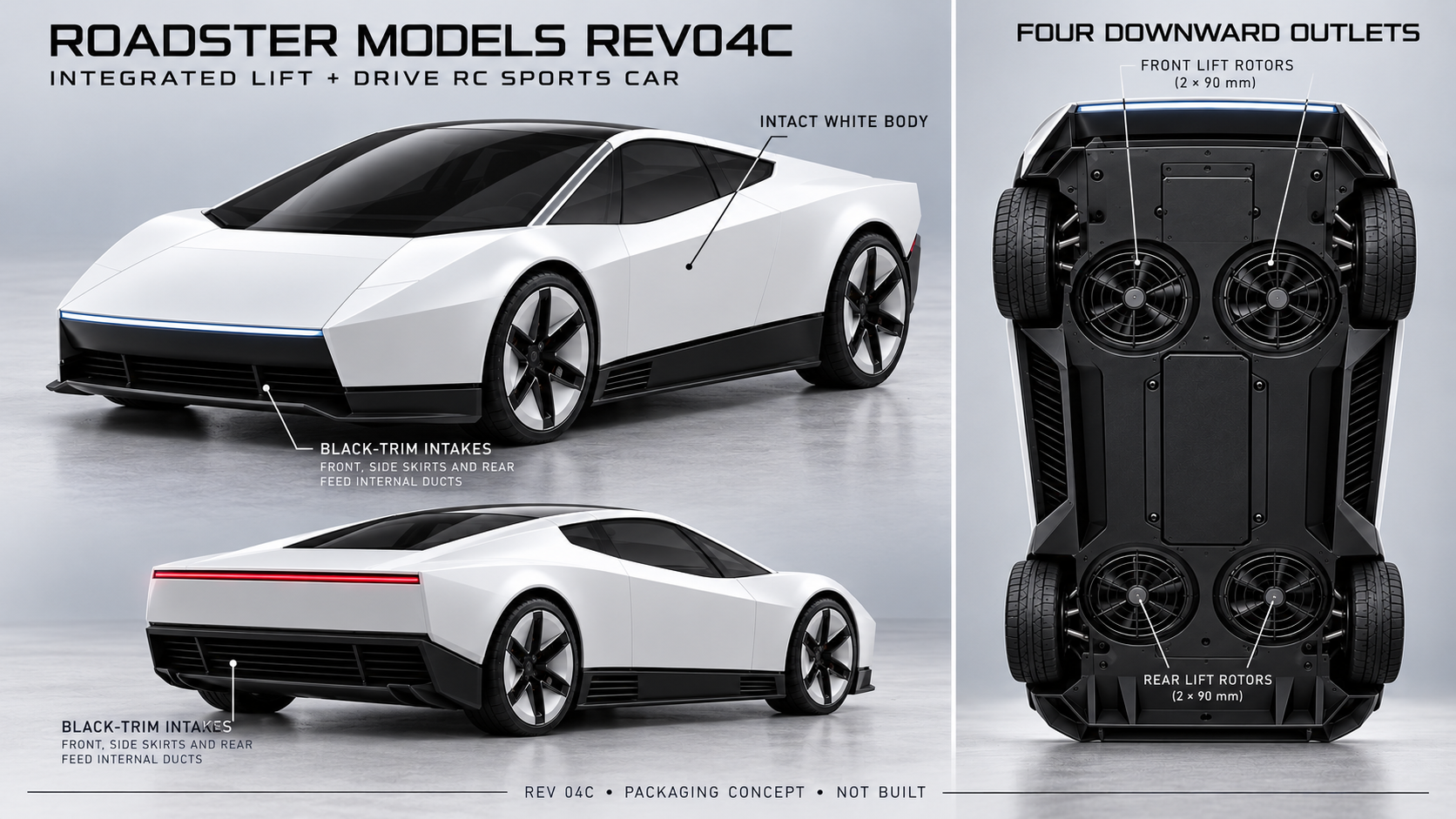
An exact scale ratio needs an agreed full-size reference and dimensions that stay consistent with it. Styling alone is not enough. Our current packaging study uses a proposed body length of 450 mm, width of 250 mm and height of 140 mm. We describe those as body targets rather than sell the project as a certified scale replica.
For a functional model, the rotor envelope, wheel travel, battery fit and access for maintenance all influence the final body. Even if a shell looks correct in a rendering, the components still need to fit in three dimensions.
Our proposed functions, one by one
Ground driving: a lightweight wheel-drive and steering arrangement is part of the intended vehicle. Speed and runtime will depend on the final components and measured mass.
Ground boost: a separate electric rear-propulsion assembly is being considered for ground acceleration. That does not make it a miniature SpaceX system.
Vertical hover: the study places four lift modules beneath an intact upper body. A 60-second hover is an initial validation milestone; twenty minutes is a long-term research goal while the intact-body architecture stays fixed. Installed thrust and vehicle control still need physical validation.
What to check before paying for a future model
Look for footage of the actual model, not just animation. Ask which functions have been tested together, what equipment comes in the box, and which battery and controller are required. Clarify operating locations, spare parts, shipping scope, taxes, cancellation terms and warranty coverage before placing an order.
For this project, the final package, price, delivery date and sales regions are not set. The site currently accepts interest requests rather than payments. Those requests do not reserve stock or create queue priority.
Help shape the first version
Would you value accurate appearance, easy ground driving, or the engineering of hover most? Those preferences can point to different tradeoffs. A collector may prioritize the silhouette; an RC builder may prioritize access and replaceable parts.
Explore the current layout and development milestones. Then use the interest form to tell us what matters to you. Your request stays separate from a future purchase decision.
Sources & scope
Sources reviewed on 22 October 2026. External reporting, documentation and manufacturer statements are attributed. RC calculations and design discussion are explanatory; they do not establish our vehicle’s flight performance.