RC basics ·
Flying RC car vs hovercraft vs drone: what is the difference?
“Hover car” can describe a craft floating on a cushion of air or a vehicle flying clear of the surface. The name alone does not tell you which experience a model offers.
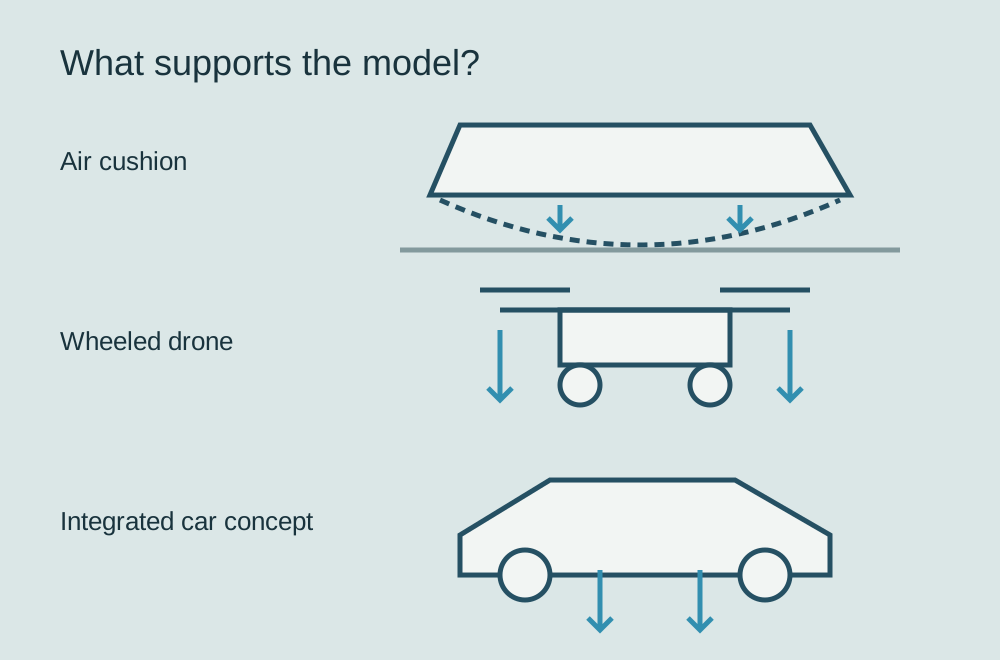
Start with what supports the vehicle
An air-cushion hovercraft uses pressure beneath the body to support its weight close to a surface. A flexible skirt may help retain that cushion. It can slide without ordinary wheel friction, but that is not the same as free flight several body heights above the ground.
A flying RC car needs a lift system that supports the vehicle when the supporting surface is no longer nearby. Many designs combine a quadrotor-style aircraft with wheels or a transforming body. Retail products such as the Hover and Drive RC Car show why shoppers encounter the categories together. A product listing is not an independent test.
A drone with wheels and an integrated car
Adding wheels to a drone can provide ground movement while retaining a layout familiar from multirotors. A car-shaped body places different demands on the lift system: airflow, rotor clearance and service access compete with the silhouette. Neither arrangement should be judged only by a photograph.
Our independent concept studies fixed lift modules below an intact upper body. That distinguishes its packaging question from an exposed-rotor drone with wheels, but does not establish better efficiency, safety or flight performance.
What to look for in a demonstration
Watch the complete sequence from ground mode to takeoff and landing. Look for a continuous view, the actual model and a clear sense of height. An edited jump, a vehicle hanging from a line and a controlled free hover demonstrate different things.
Ask whether the runtime refers to driving, flying or mixed use. A shared battery does not imply equal duration in each mode. Check whether the video is a rendering and whether claims correspond to the same battery, guards and body that will be supplied.
“Stable hover” also needs a definition
Keeping the body level is attitude control. Remaining over one spot requires a usable motion or position estimate as well. A model can maintain a level orientation and still drift. Optical flow can assist horizontal control under suitable conditions; it does not remove the need for control-system validation.
When comparing products, ask which mode was tested, what the lighting and ground surface were like, and who maintained control. Avoid assuming that a feature called “altitude hold” guarantees hands-off position hold.
Which category is ROADSTER MODELS exploring?
We are developing an integrated road-and-hover RC concept, rather than an air-cushion toy. The body and hidden underbody architecture remain the priority. Twenty minutes is a long-term hover research goal; a 60-second protected free hover remains an earlier validation milestone. Neither duration has been demonstrated by the current vehicle.
Read the battery-time guide and endurance research brief, or tell us which driving and hover features matter to you.
Sources & scope
Sources reviewed on 22 October 2026. External reporting, documentation and manufacturer statements are attributed. RC calculations and design discussion are explanatory; they do not establish our vehicle’s flight performance.