Control & sensors ·
Optical flow vs GPS: can an RC hover car stay in one spot?
A model that stays level can still drift. Keeping an RC hover car over one point requires more than an IMU, and different sensors provide different pieces of the estimate.
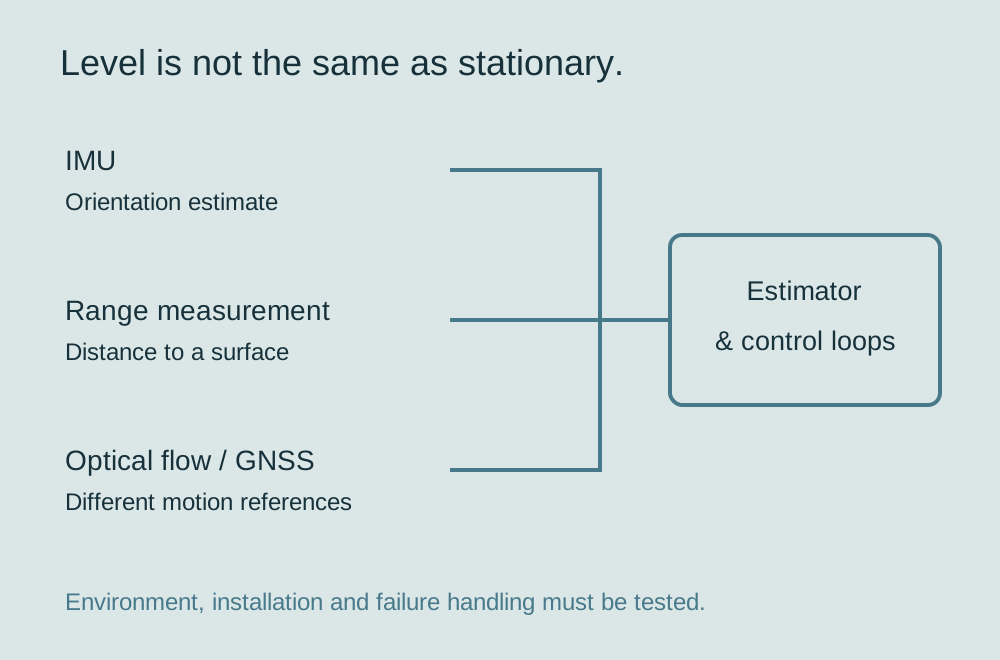
Three kinds of “hold”
Attitude control regulates orientation: roll, pitch and yaw. Height control regulates a vertical estimate. Horizontal position control needs a useful estimate of sideways motion and location. These loops work together, but satisfying one does not prove that the others are working.
That is why a model may look level while slowly crossing the floor. A short clip can hide the drift if the camera moves with it. Tests should therefore use a fixed ground reference and a declared operating area as well as a view of the vehicle.
What optical flow contributes
A downward-facing optical-flow sensor observes how ground features move in its image. A compatible range measurement helps relate that image motion to ground-relative movement. It is not a direct guarantee of an absolute global position.
ArduPilot's setup guidance explicitly includes checking the rangefinder and selecting a textured surface with suitable lighting. Sensor placement, vibration and the motion estimate must be validated on the installed vehicle, not just on a stationary electronics bench.
What GPS/GNSS contributes
A satellite navigation receiver provides a different reference. It needs suitable reception and integration with the flight estimator. A sensor that works outdoors cannot simply be assumed to work beneath a roof, and the presence of a receiver does not establish a particular hold accuracy.
Switching between navigation sources is also a control problem. ArduPilot documents GPS/non-GPS transitions as a configured behavior. Those examples are not ready-to-use parameters for a new RC hover-car design; its hardware, firmware and failure modes need their own checks.
Why a low car body makes installation important
Our concept begins close to the ground, with rotors, wheels and body structure sharing the underside. A rangefinder's near limit, field of view and line of sight all matter. So does keeping the optical view clear of obstructions and avoiding vibration that corrupts the estimate.
Twenty minutes of hovering also asks more from the whole system than one brief lift-off. Power supply stability, temperature and sensor-quality monitoring need to be logged over time. Endurance is not only a battery calculation.
Define the failure response before free hover
Test low texture, changing illumination, missing range data and degraded navigation estimates in a protected sequence. Establish which warnings appear, which modes remain available and how a trained operator can take over. A fallback attitude mode does not hold horizontal position.
Our mode rules keep ground drive and rear boost disabled in flight. A navigation-sensor anomaly requires a validated warning and recovery strategy. Those control behaviors must be implemented and tested before vehicle-level claims can be made.
See the validation gates, compare the different types of hover models, or follow the control-system research.
Sources & scope
Sources reviewed on 22 October 2026. External reporting, documentation and manufacturer statements are attributed. RC calculations and design discussion are explanatory; they do not establish our vehicle’s flight performance.