Battery & endurance ·
RC hover car battery life: estimate flight time in Wh, not mAh alone
A bigger mAh number does not by itself predict a longer hover. Start with stored energy, measured electrical power and the mass that has to stay airborne.
Why mAh is only part of the answer
Battery capacity in milliamp-hours describes charge. To estimate energy in watt-hours, multiply nominal voltage by capacity in amp-hours. A 14.8 V, 2200 mAh reference therefore corresponds to 32.56 Wh nominally. That is an arithmetic example, not a selected endurance battery for this vehicle.
The usable fraction represents energy left after reserves and practical limits. It is an assumption until a particular pack is characterized under the actual load. Loaded voltage, temperature, aging and the control system's minimum operating voltage all affect what can be used.
Energy-only runtime calculator
Enter the average electrical power measured at the battery, including propulsion and onboard systems. This calculator cannot decide whether the aircraft produces enough lift.
A worked example, not a flight claim
With the reference above and an assumed 70% usable fraction, estimated usable energy is 22.79 Wh. At a hypothetical 500 W average load, the energy-only calculation gives about 2.74 minutes. The 500 W input is illustrative, not our measured hover power.
Using that same energy for twenty minutes would require average battery power of about 68.4 W. Whether the complete underbody design can support its mass at that power is a separate aerodynamic and electrical question. Increasing battery capacity also increases the weight to be lifted, so changing the battery requires a new power estimate.
Why a camera drone's runtime is not a direct comparison
Manufacturers often distinguish forward-flight endurance from hovering endurance. DJI's Mini 4 Pro specifications list separate conditions for those measurements. A compact car body with enclosed air paths, wheel drive and additional structure cannot inherit another aircraft's figures simply by using a similar battery.
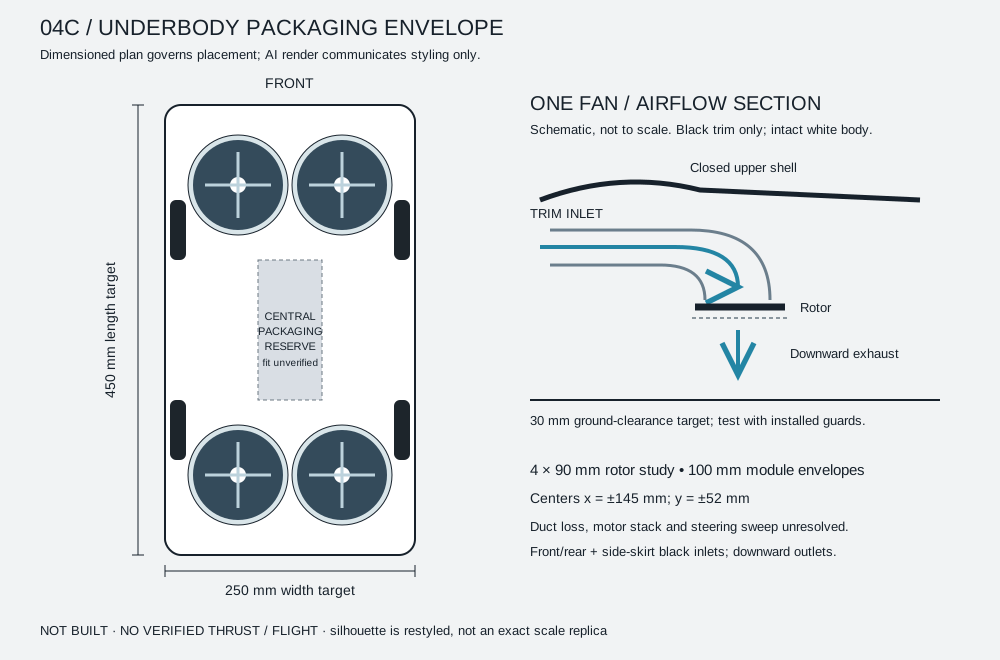
For our project, the useful input is measured power from the installed propulsion system at the force required by the measured vehicle mass. Start with repeatable module tests, then validate the full assembly and reserve policy.
Our twenty-minute research target
The architecture decision is to retain the complete car body and hidden rotors. Twenty-minute free hover is a long-term research objective, not a published capability or current battery specification. An earlier 60-second validation milestone remains part of the test sequence.
Follow the energy and mass research brief, download the blank measurement record, or register for hover development interest.
Sources & scope
Sources reviewed on 22 October 2026. External reporting, documentation and manufacturer statements are attributed. RC calculations and design discussion are explanatory; they do not establish our vehicle’s flight performance.